Andromeda 4.5
The right engine for every request.
One assistant. Behind it, several leading models, each doing the work it leads at.
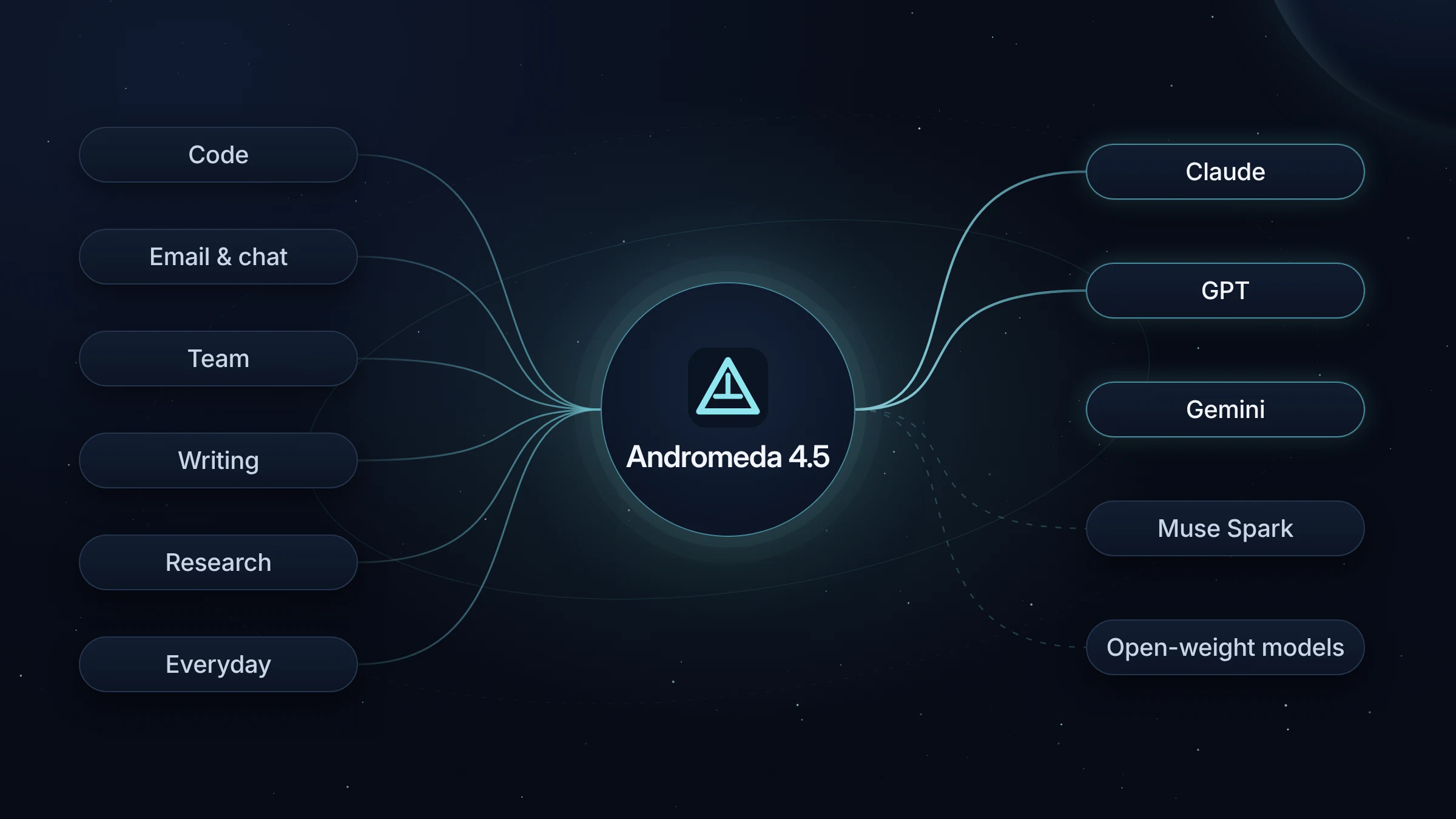
Routing by the kind of work.
Andromeda classifies each request using the whole conversation. Each kind of work has a lead engine, fallbacks and a playbook.
- Lead engine
- Claude
- Fallbacks, in order
- OpenAI, Gemini, Groq
- Playbook
- Read the relevant files before diagnosing. Name the root cause, give a focused fix with the file path, then tests that prove it.
- Lead engine
- Claude
- Fallbacks, in order
- OpenAI, Gemini, Groq
- Playbook
- Give every work item an owner, a status and a date. Show exactly what will be created before it is.
- Lead engine
- Claude
- Fallbacks, in order
- OpenAI, Gemini, Groq
- Playbook
- Summarize by who said what, what was decided and what is open. Check the calendar for conflicts before proposing a meeting.
- Lead engine
- Claude
- Fallbacks, in order
- OpenAI, Groq, Gemini
- Playbook
- Lead with the main point and respect the format: posts on X fit 280 characters, subject lines stay under 60.
- Lead engine
- Gemini
- Fallbacks, in order
- OpenAI, Claude, Groq
- Playbook
- Search first, then read the most authoritative primary sources. Keep findings apart from recommendations, and cite every page.
- Lead engine
- OpenAI
- Fallbacks, in order
- Claude, Groq, Gemini
- Playbook
- Answer directly in the first line, then add only the detail that helps.
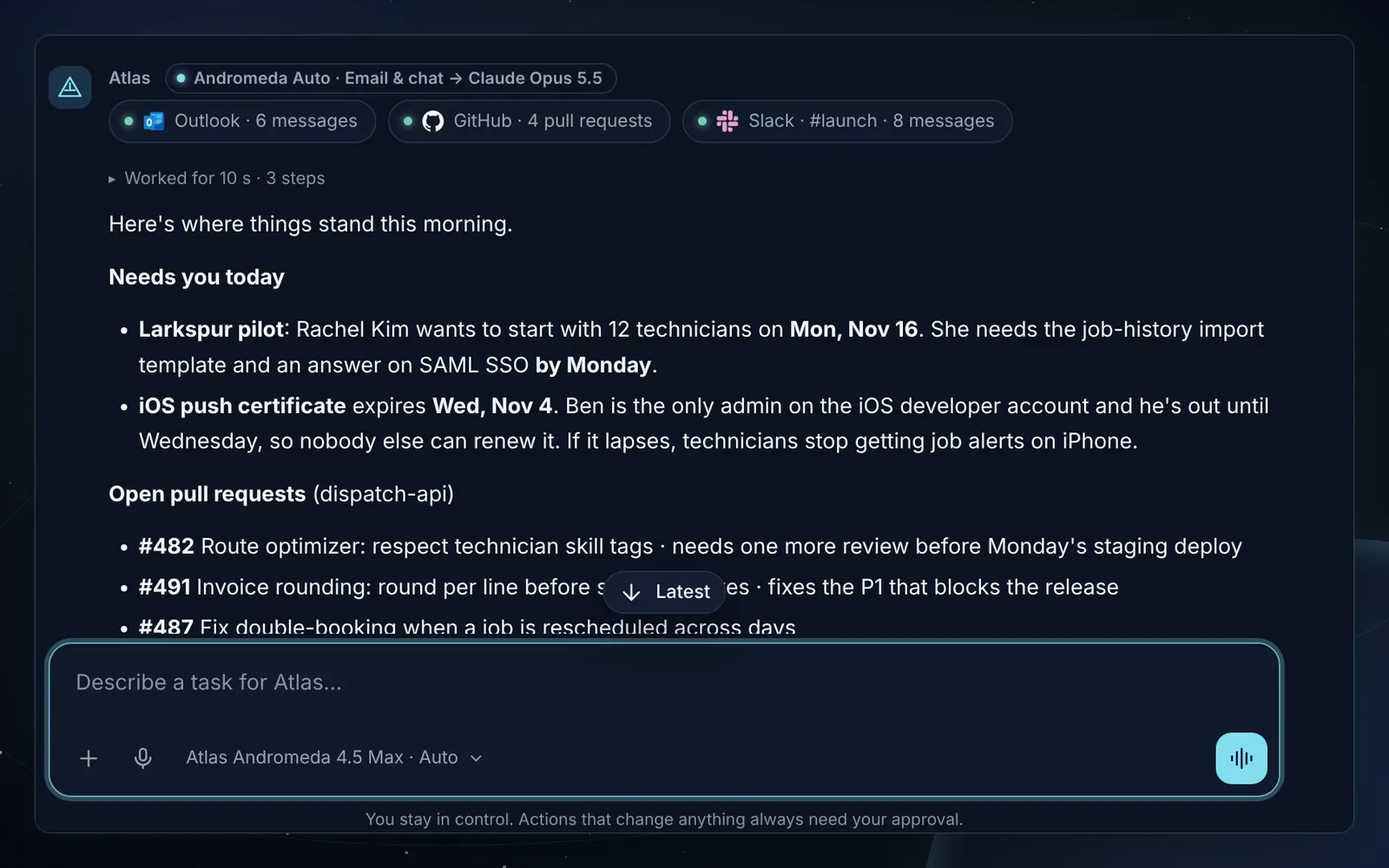
Lead engines are the default routing table. Within a route, Andromeda also weighs engine health, the minimum capability for your plan’s tier, cost and privacy, and learns from feedback and Compare picks, so the engine that answers can differ. A fast model breaks ties when the rules are unsure. Every answer is labelled; on the Elite plan’s Max tier, for example, “Andromeda 4.5 Max · Code → Claude Opus 5.5”.
Every answer says who answered.
The route, the engine and the tokens used, on every answer.
Three tiers, matched to your plan.
Each tier sets the engines Andromeda can use and how hard they think. “Try a stronger model” retries an answer one tier up, if your plan includes it.
| Tier | Plan | Anthropic | OpenAI | Built for | |
|---|---|---|---|---|---|
| Andromeda 4.5 Lite | Free | Claude Haiku 5.5 | GPT-6 Luna | Gemini 3.5 Flash-Lite | Fast answers for everyday questions |
| Andromeda 4.5 | Pro | Claude Sonnet 5.5 | GPT-6.1 Terra | Gemini 3.8 Flash | Code, research and team work |
| Andromeda 4.5 Max | Elite | Claude Opus 5.5 | GPT-6.1 Sol | Gemini 4 Argon | Frontier engines for the hardest tasks |
Andromeda also runs on Meta’s Muse Spark and on open models hosted by Groq, Cerebras, SambaNova and Hugging Face. Model versions reflect the current configuration and change as providers release new models. All names are trademarks of their owners; Atlas accesses these models through each provider’s API.
One prompt. Every engine.
Compare runs one request on every configured engine and streams the answers side by side. Keep one; the conversation continues on that engine. Pro and Elite.
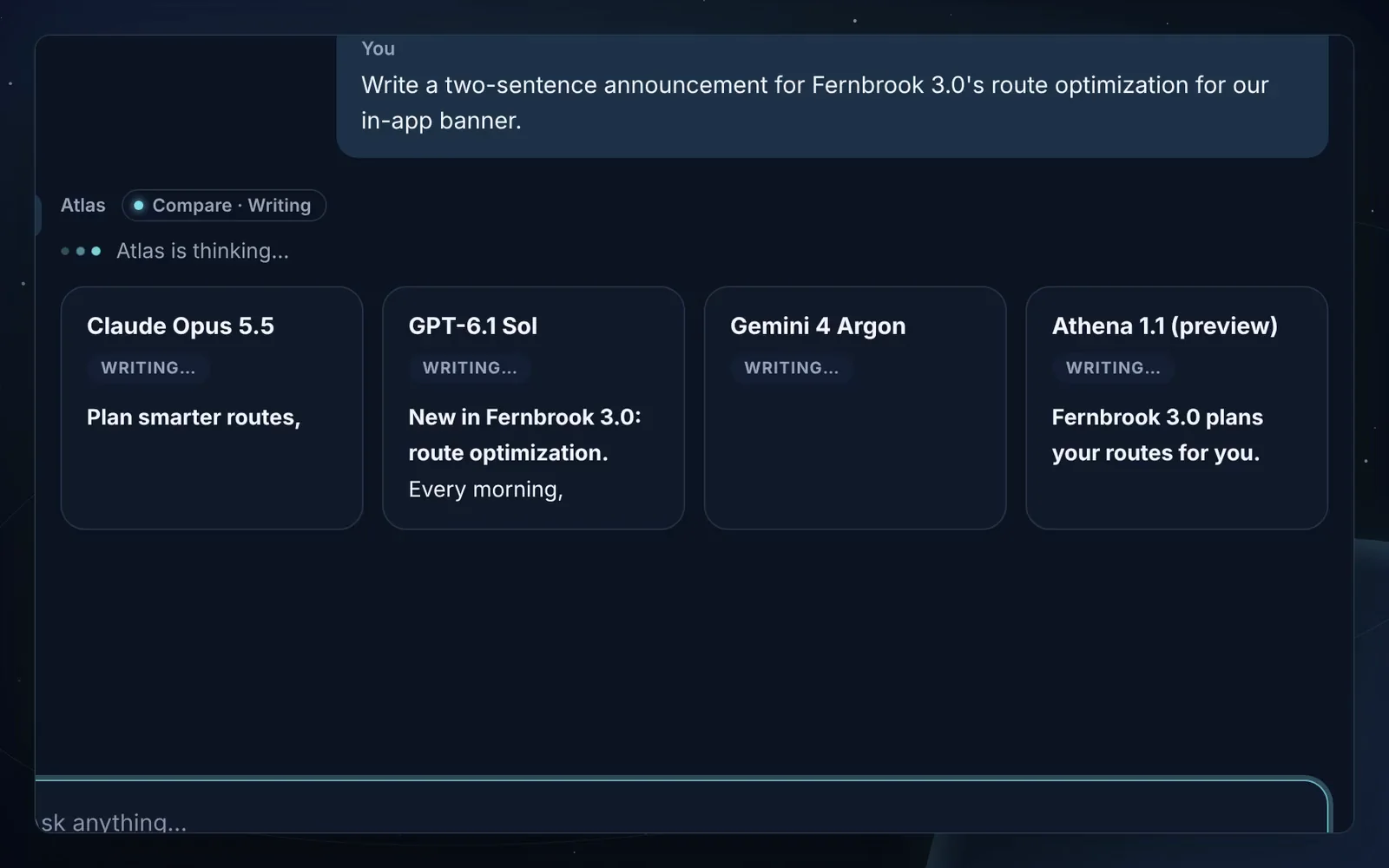
Your picks shape routing
Picks are counted by kind of task. Once enough people compare a kind of task, Auto puts the engine they keep most often first. No single pick decides it.
Pin an engine
Keep Andromeda Auto, or pin a conversation to Claude, GPT, Gemini or Groq. A pinned engine is never swapped silently.
Athena joins in
Where available, Athena 1.1 appears as a column, so you can judge it against the others.
Built to keep going.
Engines go down, get busy or stall. You rarely notice.
Failover before the first word
If an engine is busy, down or rejects a request before any text streams, Andromeda switches to the next, and the failed one rests for a minute.
Handoff mid-answer
If an engine stops part way, the next continues from exactly there, so you see one answer. Each part is billed at its own engine’s rate.
Source check on every engine
Numbers and links that appear in nothing Atlas read fail the check. A failing answer is rewritten once by a more capable engine.
Privacy-aware routing
Engines whose terms allow training never receive your attachments, photos, memories or connected-app data.
Shared engine health
Every server instance shares what it learns about failures and response times, so one bad engine is benched for everyone.
No charge for failures
If the engines fail before any of the answer reaches you, you are not charged.
The Andromeda Rulebook.
Andromeda decides which model answers, which tools run and what you are charged, so it plays by published rules. Most are enforced in code and covered by tests.
What Andromeda is, and is not
Andromeda is Atlas AI’s software layer over third-party models: routing, instructions, rules, checks and billing. It is not a separately trained foundation model. When asked, it says so. Our own model is Athena 1.1.

Put Atlas to work.
Atlas AI is in invite-only early access on the web and Windows.